
3rd MCAP Annual Convening
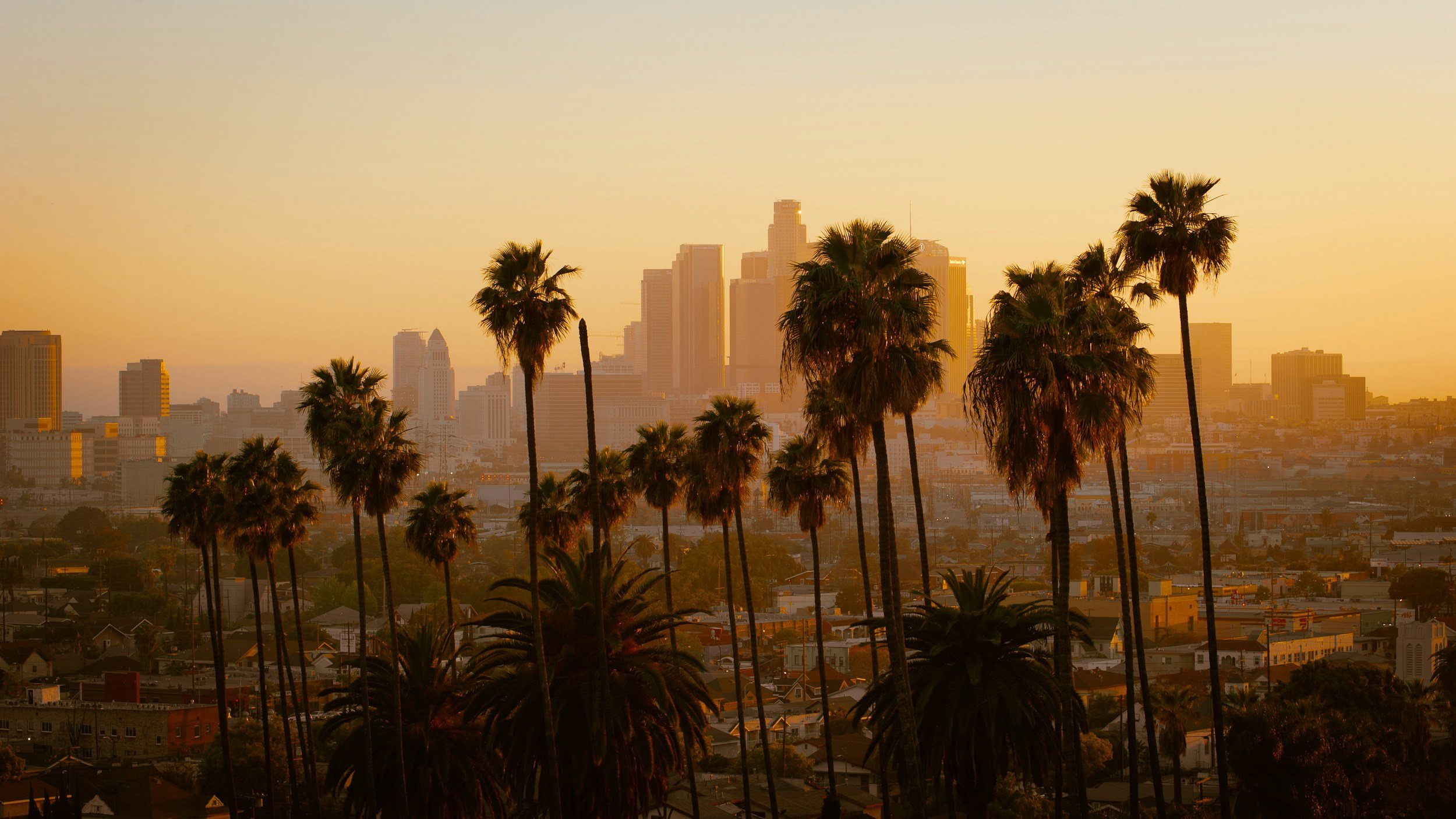
Los Angeles, California, April 14-17, 2026
Living Labs
California
April 14-17, 2026

What Are Living Labs?
Living labs are a critical component of knowledge exchange for the Partnership and allow regions to showcase an array of programs, policies, or projects that help other regions to contextualize local resilience challenges and explore new solutions or approaches. The Living Labs programming serves four primary purposes:
Immerse MCAP members in regions’ overall resilience narrative - and elevate the region’s risks and on-the-ground solutions and opportunities
Uplift projects, policies and programs underway that illustrate diverse approaches to tackling climate risk and underlying vulnerabilities
Provide an opportunity to elevate important local resilience leaders from diverse sectors
Inspire attending MCAP members with new insights and tactics that can inform their climate resilience work as a collective and back at home
Over the course of four days, MCAP members will have the opportunity to hear from an array of local experts working together to tackle the region’s challenges at the nexus of drought, extreme heat, and wildfire.
Living Labs
California
Sites, Agenda, & Resources
Tuesday, April 14th
Site 2: Los Angeles CleanTech Incubator
Reducing urban heat through climate-smart infrastructure, green space investment, innovation-driven policy, and community resilience partnerships.
This site showcased how cities can adapt to extreme heat through innovative cooling infrastructure and community-driven urban design. Projects like Cool Seal reflective pavement, cool roofs, and de-paving initiatives demonstrated practical ways to reduce ambient temperatures while improving neighborhood resilience. The site also emphasized that long-term heat adaptation depends on strong partnerships between governments, utilities, researchers, and local communities to scale climate technologies, expand green infrastructure, and integrate cooling benefits into broader clean energy and sustainability goals.
Resources
Resources
Site 1: Baldwin Hills Scenic Overlook
Developing resilient, heat-ready communities through strategic partnerships, nature-based solutions, and community hub planning.
This site highlighted that effective extreme heat solutions combine nature-based infrastructure, community-centered design, and cross-sector partnerships to create resilient public spaces. Designing spaces that prioritize vulnerable communities and incorporate cooling shade infrastructure, water accessibility, and long-term green investment reduce heat exposure, improve emergency preparedness, and increase community resilience.
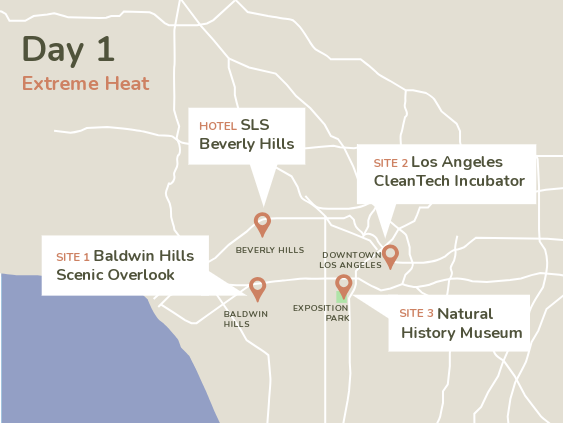
Site 3: Exposition Park
Planning heat-resilient events and spaces for the 2028 Olympics while supporting long-term community resilience.
This site visit emphasized that preparing for extreme heat requires embedding climate resilience into long-term public investment and urban design. Initiatives like LA 28’s “Resilient by Nature” emphasized the importance of cooling green spaces, native vegetation, and water-conscious landscapes to reduce urban heat while strengthening community resilience to future climate shocks. The site also demonstrated how partnerships, dedicated funding, and community-based projects can help cities build adaptive infrastructure that supports both major events and everyday quality of life in a hotter climate.
Resources
LA28 Unveils Impact & Sustainability Plan, Charting a Uniquely Californian Legacy for the Games
LA28 Resilience Champions Fund Opens Application Process
Wednesday, April 15th
Building climate resilience through urban wildfire prevention, vegetation management, and paid youth workforce training in emergency response and conservation.
This site highlighted the shift in state fire policy from reactive suppression to proactive land stewardship through fuel reduction, habitat restoration, and prescribed fire. The visit centered on the role of the California Conservation Corps, a workforce development program that trains youth in long-term emergency response and environmental management. The visit included demonstrations of fuel reduction techniques and highlighted the program’s positive impact on members’ professional growth.
Site 2: Eaton Canyon Reservoir
Strengthening wildfire resilience through recovery-informed planning, landscape restoration, and proactive fuel reduction in high-risk wildland-urban areas.
This site showcased the Eaton Fire and its catastrophic impacts, highlighting the need for proactive fuel management, faster implementation of wildfire mitigation projects, and coordinated multi-agency response systems. It featured long-term ecological recovery strategies such as creating buffer zones and wildlife corridors that strengthen both community safety and landscape resilience in the wildland-urban interface.
CCC Factsheet / Press Kit
Wildfire Firefighting Program
Pasadena Info Sheet
Resources
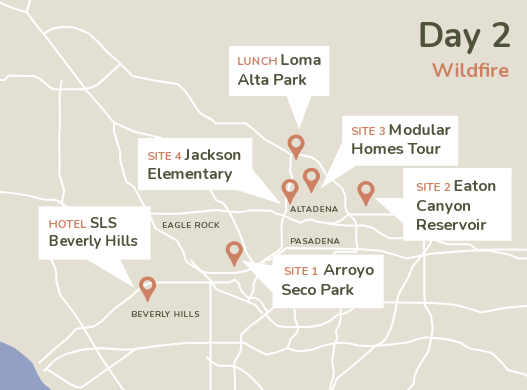
Site 1: Arroyo Seco Park South
Site 3: Altadena and Loma Alta Park
Post-wildfire disaster recovery through a “people-first” strategy
This site showed that effective disaster recovery must put people and communities first. Following the Eaton Fire, recovery efforts focused not just on rebuilding homes, but on restoring parks, ecosystems, and community identity while supporting residents through trauma, insurance challenges, and future climate risks. The visit highlighted how strong partnerships between governments, nonprofits, and local communities are essential for building long-term resilience after climate disasters.
Site 4: Mary W. Jackson STEAM (Science, Technology, Engineering, Art, and Math) Multilingual Magnet Elementary
Advancing climate resilience through urban greening, drought-tolerant landscape design, and community-centered wildfire mitigation strategies and resources
This site, a recipient of California urban greening grants, demonstrated how urban greening and water-harvesting infrastructure can strengthen both wildfire and community wellbeing. By transforming schools and public spaces into green community hubs, the project showed how nature-based solutions can reduce fire risk, cool neighborhoods, improve drought resilience, and support recovery capacity. The site also highlighted the importance of cross-sector partnerships that combine ecological design, education, and community stewardship to build long-term resilience.
Resources
Resources
Resources
Thursday, April 16th
Building resilient communities through adaptive design, equitable public spaces, heritage preservation, and community art.
This site demonstrated how urban development can be used as a tool for both climate resilience and cultural preservation. Through a reparative development model, the project invested in public spaces, local businesses, and cultural identity while incorporating drought-tolerant landscaping, water-capture infrastructure, and community-centered design. The visit showed how art, storytelling, and local leadership can be integrated into resilient urban planning that supports both environmental sustainability and economic opportunity.
Site 2: SoFi Stadium
Using sustainable landscaping, stormwater reuse, native drought-tolerant plants, and heat-reflective, shaded design to reduce water stress and urban heat.
This site showcased how large-scale infrastructure can integrate sustainable resource use while also prioritizing design and public experience. It highlighted innovative water management systems such as stormwater capture and recycled water reuse that eliminate the need for potable water in operations and irrigation, alongside designs that center natural ventilation systems and native Mediterranean planting. It demonstrated that environmental resilience, aesthetic quality, and community benefit can be achieved together in major public venues.
Resources
Resources
Resources
Site 1: Destination Crenshaw
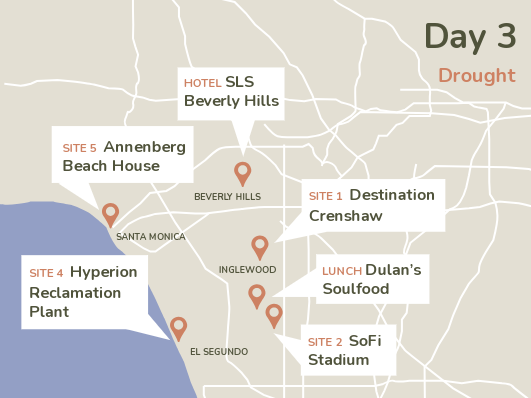
Site 3: Hyperion Water Reclamation Plant
This site highlighted how drought adaptation will depend on large-scale water recycling, local water production, and sustainable agricultural practices. The Hyperion Water Reclamation Plant demonstrated how advanced purification technologies can safely transform wastewater into potable water and groundwater recharge supplies, with the potential to meet up to 50% of Los Angeles’ water demand. More broadly, the project emphasized the importance of integrating innovative technology, conservation, environmental restoration, and long-term planning to build resilient urban and agricultural water systems in a hotter, drier future.
Resources
Site 4: Ballona Wetlands Ecological Reserve
Protecting wetland ecosystems to restore watershed health, sustain biodiversity, and strengthen community stewardship
This site demonstrated how large-scale wetland restoration can serve as a powerful nature-based solution for climate resilience. By restoring tidal marshes and reconnecting a degraded watershed, the project shows how ecological design can improve flood protection, filter stormwater, support biodiversity, and strengthen water quality while also addressing drought and extreme rainfall risks. It also highlighted the importance of preserving remaining urban wetlands as critical habitat and climate infrastructure, while using hands-on
The MCAP Living Labs were co-design and coordinated by:
Special thanks to all our local implementation partners for sharing their solutions with the Partnership!